
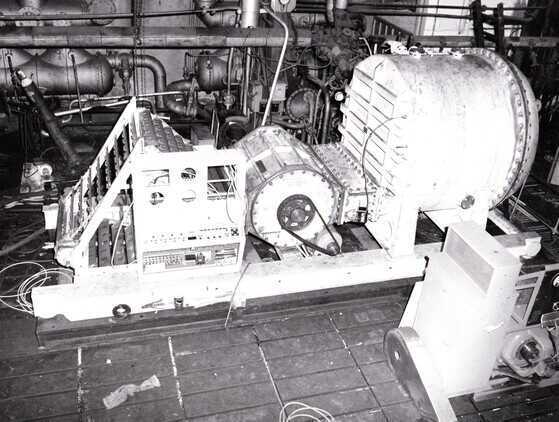
1967: Hydrolock, a manufacturer of continuous sterilizers, was founded
An order for factory trawlers in 1967 led Ateliers et Chantiers de Bretagne (ACB) to explore a new market for canning factories: that of continuous sterilisers, equipment capable of carrying out all stages of can processing without interrupting the production flow. This equipment is still manufactured in Le Bignon by the company Hydrolock.
A Soviet order for Ateliers et Chantiers de Bretagne
In April 1963, the Soviet procurement agency SUDOIMPORT placed an order with Ateliers et Chantiers de Bretagne (ACB) for three factory trawlers of a new design capable of producing 100,000 tins per day, equivalent to a shore-based factory employing 300 to 400 workers.
The first in this series, the Natalia Kovshova is:
– A stern trawler designed to tow a net with a catch capacity of 20 tonnes,
– A cargo ship whose refrigerated holds can store 5 million tins, 300 tonnes of frozen fish, 300 cubic metres of fish meal, and 118 cubic metres of fish oil,
– An oil tanker, as at the start of an 80-day campaign it carries 2,500 cubic metres of fuel oil and 320 cubic metres of lubricating oil,
– A passenger ship accommodating 232 people, including 80 male and 80 female workers (non-seafarers), in the physical and psychological conditions required for four months’ work in cold or tropical seas,
– A radar station equipped with particularly impressive facilities for navigation, detection and telecommunications,
– And finally, a fully automated canning factory.
Translated with DeepL.com (free version)
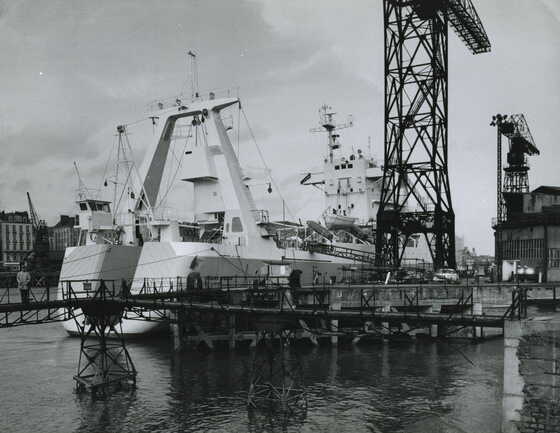
The trawler-cannery vessel ‘Natalia Kovshova’ moored at the Nantes shipyards
Date of document: 1966
Early approaches to sterilisation at ACB
At that time, Ateliers et Chantiers de Bretagne was well-equipped for naval architecture, general mechanical engineering, sheet metal work, power and fluid systems, seawater distillation, and so on. However, designing a canning factory was a new undertaking.
Initially, ACB’s engineers considered entrusting this part of the project to a specialist engineering firm. They quickly changed their minds, however, given the constraints associated with the ship. Indeed, the installation of an on-board canning factory primarily involved issues relating to the automatic interconnection of machinery supplied by specialist firms. For the continuous sterilisation of tins, the known systems, whether using hydrostatic seals or valves, are not suitable for shipboard installation due to their bulk. Furthermore, this equipment does not meet the requirement to process different tin shapes, both round and rectangular.
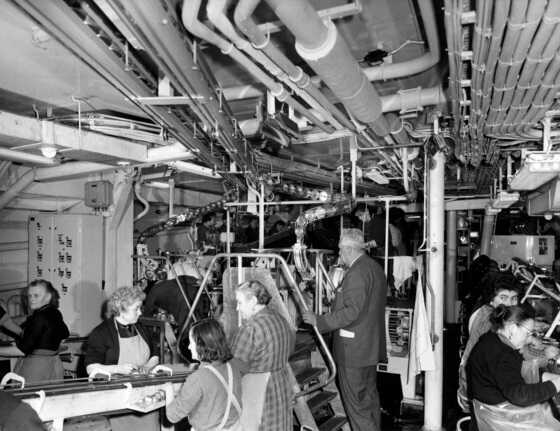
Women workers on the freezer trawler ‘Maria Polivanova’
Date of document: September–October 196
ACB’s engineers received highly effective guidance from the laboratories of J.J. Carnaud and Cassegrain. It was on the basis of these initial approaches, and by maintaining a fresh perspective, that ACB developed the rather innovative engineering design for the Natalia Kovshova canning factory.
The solution adopted consists of a system that:
– Receives the streams of cans directly and in bulk from the production line,
– Automatically feeds a bank of ten batch autoclaves from above. These autoclaves, which are conical in shape, slightly inclined and fitted with a 400-millimetre opening at the base, allow for automatic gravity discharge onto a conveyor belt that fills all sizes of sterilised tins,
– Collects these tins from below.
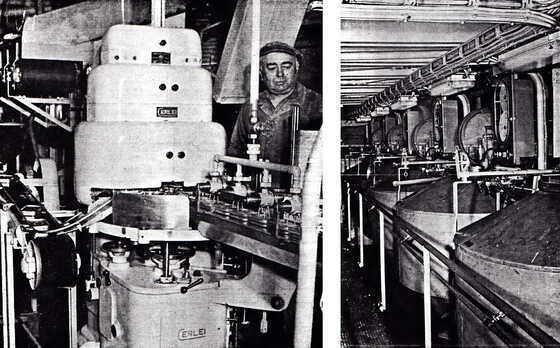
A steriliser and the conical autoclaves at the ‘Natalia Kovshova’ canning factory
Date of document: September–October 1966
The packaging line has a throughput of 70 tins per minute. The complete design and construction were carried out by Ets Bourriaud, a Nantes-based manufacturer specialising in stainless steel fabrication.
The indirect benefits of the project
During their research, ACB’s engineers made contact with Max Beauvais, director of Laboratoires Saint-Georges Motel, well known among canners for his innovative work in the field of sterilisation, notably the ‘Stériflamme’.
As early as 1957, Max Beauvais began research to build a continuous steriliser capable of reaching a temperature of 140°C. In 1961, this research led to the creation of the ‘Tubomatic’. Unfortunately, its construction revealed some mechanical weaknesses that were difficult to resolve, and to the great disappointment of many canners, the prototype had to be abandoned. However, contact with Ateliers et Chantiers de Bretagne created a new dynamic and enabled a new project to be brought out of the drawing board.
Thus, in 1966, the prototype of the Hydrolock was built. It adopted the basic principle of the ‘Tubomatic’ but through completely different mechanical means.
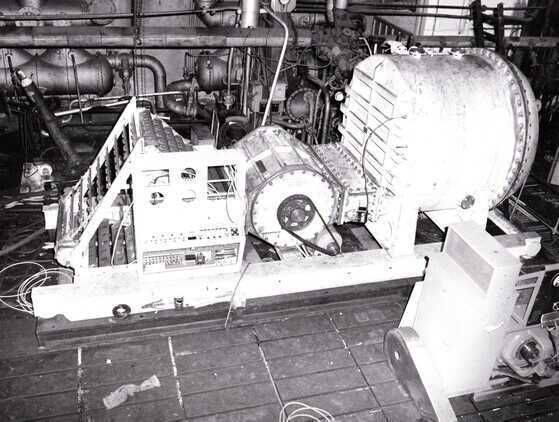
Hydrolock prototype in the ACB workshops
Document date: February 1967
The Hydrolock is designed to operate at temperatures above 130°C with continuous agitation of the products to allow rapid heat diffusion within the chamber, thereby improving the organoleptic qualities in many cases (which stimulate the sense of flavour, particularly taste and smell). This process achieves the same sterilisation levels as those obtained with conventional equipment, but with cycles reduced by half and, in some cases, by more than two-thirds for certain products.
The products are loaded into open containers or tubes. The containers holding the cans are conveyed by a double conveyor chain, through a sealing hopper, into a pressurised sterilisation chamber. Sterilisation is carried out using either pure steam or an air-steam mixture. In this case, the overpressure can be adjusted independently of the temperature. Cooling takes place in water, also within the pressurised chamber, and is supplemented by cooling at atmospheric pressure. For certain flexible packaging, cooling takes place within the pressurised chamber. The products are in constant rotation.
The history of the Hydrolock begins
French patent No. 1,492,032 was granted on 10 July 1967 to Max Beauvais and Ateliers et Chantiers de Nantes (Brittany-Loire). This patent was improved and updated in 1971, in favour of Ateliers et Chantiers de Bretagne. The Hydrolock trademark was registered on 28 December 1971. Two licences were granted to Rexham Corporation in the United States and Yamato Scale Co. Ltd in Japan.
Industrial applications followed: in 1967, the first Hydrolock sterilised 60 sachets per minute as part of the research programme at Reynolds Metal Company in the United States. Then, in 1968, the first industrial Hydrolock was commissioned for 5-kilogram tins in France (Peny factory). Without waiting for the first feedback from the first steriliser operating under industrial conditions, several French canners placed orders with ACB for Hydrolock sterilisers. In total, five were ordered for the 1970 season and four for the 1971 season. Its success was due to its ability to adapt to all types of product, from tinned goods to milk bottles, to reduce processing times and to optimise organoleptic qualities.
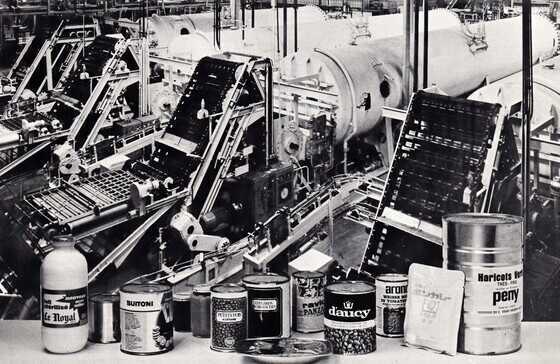
Hydroclock Steriliser Range
Document date: November 1972
The Alsthom Era
In 1976, Alsthom acquired Ateliers et Chantiers de Bretagne. The ACB division marketing Hydrolock sterilisers, based in Nantes, acquired all the patents of its competitor Pierre Carvallo in 1977, in the hope of designing a high-capacity unit for an animal feed company. The collaboration proved difficult and the project came to nothing.
At that time, all the components of the Hydrolock were manufactured at the Ateliers et Chantiers de Bretagne site. Operations were spread out on either side of Boulevard Léon-Bureau. A tunnel beneath the boulevard connected the two sites. The design offices and manufacturing facilities were located where the ‘Éléphant des Machines de l’île’—well known to the people of Nantes—now stands.
On the other side of the boulevard, assembly took place in the Kuhlmann workshop until 1985, when this hall was demolished. After 1985, all operations were consolidated in the halls at the Alstom site on Rue de la Tour-d’Auvergne, specifically in Hall 6.
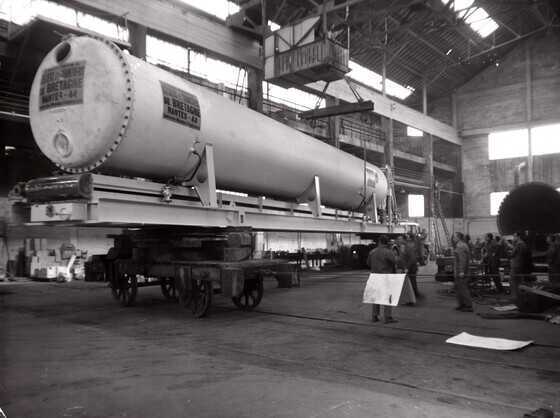
Handling an Hydrolock in the Kuhlmann workshop
Document date: Before 1985
Until 1985, four to five sterilisers were built each year, for both the canning and dairy industries.
After 1985, orders were limited to the dairy industry. Thanks to the Alstom Group’s global reputation, ACB built several ‘turnkey’ plants incorporating the Hydrolock.
In 2008, in addition to optimising the energy efficiency of its equipment, Hydrolock offered its two long-standing French customers a new steriliser concept based on its experience with machinery for dairies. This innovation enabled the company to tap into new markets such as the sterilisation of vacuum tins for maize processing, a sector previously reserved for its competitors. The clients followed suit, each ordering two high-capacity sterilisers (1,200 tins per minute). Hydrolock was back in business in the canning sector.
From a major group to an independent company
In 2014, the Hydrolock business was sold and became fully independent. Its design offices and assembly plant were moved to brand-new premises in the Forêt business park in Le Bignon, near Nantes. Since then, the company has been selling two to three machines a year, mainly for export worldwide, in a niche market facing two to three competitors.
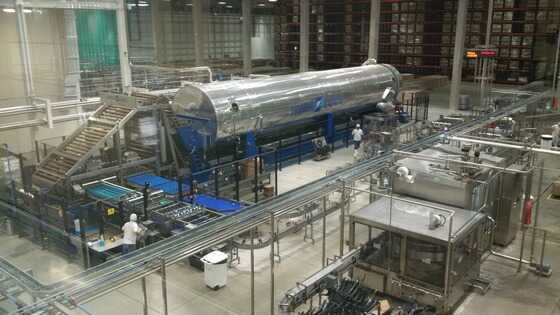
Plant incorporating a new-generation Hydrolock
Document date: 23/03/2017
The lines can sterilise up to 1,200 cans per minute. The largest units can be over 30 metres long, 3.5 metres wide and 6 metres high. They weigh over 100 tonnes. They are mainly constructed from stainless steel. The company continues to innovate and offers solutions to meet decarbonisation challenges. It adapts to new packaging, particularly recycled materials (steel, aluminium, glass).
Yannick Fortin
Association La conserve des Salorges à la Lune
2026